|
|
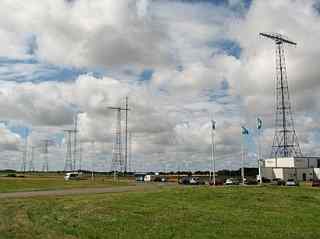
| Varberg (Sweden) - original longwave station, operates once a year for special events |
|
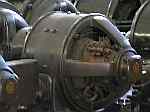
| Varberg (Sweden) longwave transmitter in 2011 |
Wireless Telephony Advancements on Longwave
The years 1908-1915 saw
moderate progress made in the use of the triode valve for radio telephony transmissions. Some of the more important long-distance
events are as follows, which were radiated on what would become the longwave band.
1908 - de Forest succeeded with
test transmissions from the Eiffel Tower, Paris, heard up to 800 km away
1910 - de Forest sent a program from the Metropolitan Opera building, using 500 kW
1914 - a Belgian station came on the air at Larken
1915 - in Arlington, NY, the US Navy station sent speech and music to Paris and elsewhere.
The period 1914-1919 during
WW1 was a time when private radio experimentation ceased or was banned in many countries. Nevertheless, the war effort saw
rapid development of radio communications for military purposes.
By 1919, radio experimentation by returned servicemen
started to boom. In Australia and England, special permission had to be obtained from the Governments before private experiments
could take place, either for radio telegraphy or radio telephony.
An important event in 1919 was the granting of a license
by the British Government to the Marconi Wireless Telegraph Company, resulting in the opening of a 6 kW longwave telephony
transmitter at Chelmsford, Essex. Many demonstration broadcasts were transmitted, and heard in various countries, on a longwave
frequency of about 120 kHz, with the callsign 2MT.
Many demonstration broadcasts were given, including one in which the voice of
Dame Nellie Melba was featured.
Some of those were received as far away as Iran, Madrid, and various other European
countries.
|
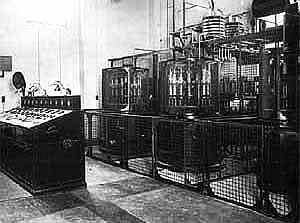
| 1927 - Rugby (UK) longwave telephony transmitters |
In 1920, the world's first wireless telephone news
service commenced from the Chelmsford station, and the public interest was stimulated in the same year by special transmissions
to Australia. Regular broadcasts from Chelmsford started in 1921.
1920 was the year in which serious research into wireless
telephony, with innumerable tests and experiments, commenced - one such achievement was the relay of concert programs of distances
up to 1600 km to the SS Victoria.
In Australia, as well as in many other countries, radio telephone
links were being set up on a worldwide basis - circuits were established to such countries as UK, NZ, Canada and USA, following
the changeover from spark to valve operated equipment.
As early as 1921, American amateur radio operators spoke over long distances on about
1500 kHz, in spectrum which would become the medium wave band.
In 1922, Marconi opened the famous London station
2LO, and in the same year the BBC was formed, initially using the Marconi transmitter 2LO for the first broadcasts in the
mediumwave band.
Elsewhere in Europe, on both longwave and mediumwave, broadcasts commenced from
the Eiffel Tower.
In 1922, longwave stations opened in Lusanne (Switzerland) and Moscow.
Other notable stations opened on longwave included:
· 1918 XWA Canada
· 1919 9XM University of Wisconsin, Canada
· 1919 PCGG Holland
· 1920 Buenos Aires, Argentina
· 1920 8MK Detroit
· 1920 KDKA Pittsburgh, Pa
· 1922 WBZ Springfield, Mass
Even though mediumwave development had begun, the installation of commercial
longwave stations continued well into the 1930s. From about 1918 until the mid-1930s
there were well over 100 longwave stations in operation, and new longwave stations were set up in Argentina, USA, Turkey,
Iceland, India, Afghanistan and Hong Kong.
But this form of transmission of radio telephony was extremely limited and no
further progress occurred, considering the serious practical difficulties involved. The medium just wasn't adequate for telephony
transmissions and another form of technology was necessary.
|